Operación Pescador in Oaxaca and ICE raids in the US are very much related. They have been happening in Mexico for years. One could think that they are unrelated; however, on a bigger scale, they’re part of the same current. Just branded differently and conveniently adapted to each context, but in the end, the imperialism and colonialism behind them are just the same.
One fact that I want to highlight about the raids (official and unofficial ones) is that they always target the same people: the native and enslaved people of this land, and they’re always conducted by the same elites, the institutional ones. It happens in different jurisdictions, but the message is the same: We decide who can inhabit the territory, and we enforce it whether by the law or under the table; through the official channels (the police) or the illegal ones (organized crime).
I could point this text to the usefulness of those MOs along with the prison system, or even the police as an institution to protect the interests of the elites, but today I’ll focus on another aspect, also related and as relevant as those; the narratives around those practices. A common thing to hear from foreigners is that they idealize Mexico as a great place to live, compared to the US, because it’s perceived as being better here. Our president is doing better; people here are more friendly and drawn to community life, life is cheaper, and so on…
Well, no, it is not. We live the same problems that a lot of people experience in other parts of the world, but the stories that you’ve been told are quite different. Mexicans are friendly to you because you’re from a country that is sold to us as something aspirational, especially if you’re white. And the fact that you probably barely heard of these practices here is because they don’t affect you.
Back to the raids, organized crime is an extension of the state, the Marines drive local police patrols, abductions with unplated cars, activists killed and intimidated by paramilitary groups. There’s a weird gray area where jurisdictions fade along with accountability. There are so many stories of disappeared people that started to intensify after Felipe Calderón declared an open war on some cartels while supporting others and increasing their business along with many corporate and corrupt interests. They converted Mexico into a graveyard, and to make up the numbers, they started disappearing people by getting rid of the bodies after killing them; if there are no corpses, they don’t count for the official body count and the government’s responsibility to take action against it.
The disappeared people are not necessarily rich kids from the cities or so-called expats. They have recruited and abducted poor people from rural areas and people crossing the country from Central and South America. Human trafficking has also been a big business happening here. The stories and cases are endless. They’re always towards the sector of the population we don’t care about. The expendables, the brown and black people, the indigenous, the poor, the sex workers, the workforce. Criminalization techniques against them are also part of the discourse used in media, but also by the population: “Seguro andaba en malos pasos” (he was probably up to something shady).
Every time a person who doesn’t belong to the small percent of the richest replicates those narratives, that is a victory for the elites; they successfully applied their propaganda to the masses and have us repeating their discourses.
Operation Fisher, if you allow me the bad translation, is an operation conducted by Oaxaca City’s government to whitewash the face of the markets and the peripheral neighborhoods of the city. Needless to say, this operation was arbitrary and violated the human rights of the people who were illegally detained.
They decided that the homeless and people they thought looked criminal would be arrested, and they did. This measure was taken by the current city government in office, whose head is well known to be part of an industrial Mezcal brand and a big entrepreneurs’ network in Oaxaca.
In the zine about gentrification, I mention a practice that is about cleaning the city of Oaxaca under racial profiling. Even though I based that affirmation on friends’ experiences that I got to witness, and social media posts. Those were individual events, not isolated and not uncommon; they happen under fire at will modality. Still institutional but unofficial, not publicly recognized.
This administration, whose head is part of the elites I mention in the zine as well, has decided to openly conduct those operations as an official and very public program to keep arresting people to whitewash touristic areas like Mercado de Abastos and downtown Oaxaca for the sake of public security. They even decided to extend these operatives to the metropolitan/peripheral regions in Oaxaca City. The arbitrary arrests are based on people’s appearance, race, and housing status; everything is supported by the general population under a racist narrative of who the bad guys are.
Propaganda and its Narratives
As the headline of this website says, dismantling dominant narratives is something we as a society need to do to change the stories we tell, including the stories in our minds, the ones that subconsciously tell us who is dangerous and who is not; who is disposable and who is not; who matters and who doesn’t. I remember last year I read on a post on social media (which I didn’t save unfortunately) that claimed there was a surprise attack on London and dozens of people were killed and more wounded. Then, in the comments section, plenty of people were very concerned and trying to find out what actually happened. Then the author made a point, apologizing and saying that there was a typo; he meant Gaza, in Palestine. Then the narrative changed, and people in general stopped caring about it.
After decades of colonial propaganda that crossed international borders through space and time, we as a global society bought the idea that certain bodies are more important than others. We bought the premise, even on a subconscious level, that certain people are more intelligent than others. More civilized, more organized, but also the contrary, than others are lazier, violent, and not worthy of dignity.
Propaganda is one of the tools that powerful people have been using for a long time to convince and manipulate the masses about their interests, and the way it shapes our thinking and how we relate to the rest of the world is truly a masterpiece of manipulation. I don’t mean this positively, I just wanted to overemphasize how effective it has been across the population across the world. Take islamophobia tropes; the government of the US and all its powerful arm of propaganda have worked so hard on creating this image of arab people dedicated to blowing up things. All of that in hundreds of movies, cartoons, books, you name it, even in a humorous way. This video is a perfect example of it:
These are the types of things that keep blowing my mind. After so many years of people debunking and raising awareness about those stereotypes and how harmful they are, a large number of people still find this type of content funny. We, as a society, still have ingrained in our minds the foundation that makes this trope possible. Propaganda is effective and none of us is immune to it. How many movies and videos like this have been produced that reinforce the idea that muslim people (usually associated with arab people) make bombs. Just take a look at the comments section of that video, please do. And tell me what you find there.
Operación Pescador Oaxaca. How is it Related?
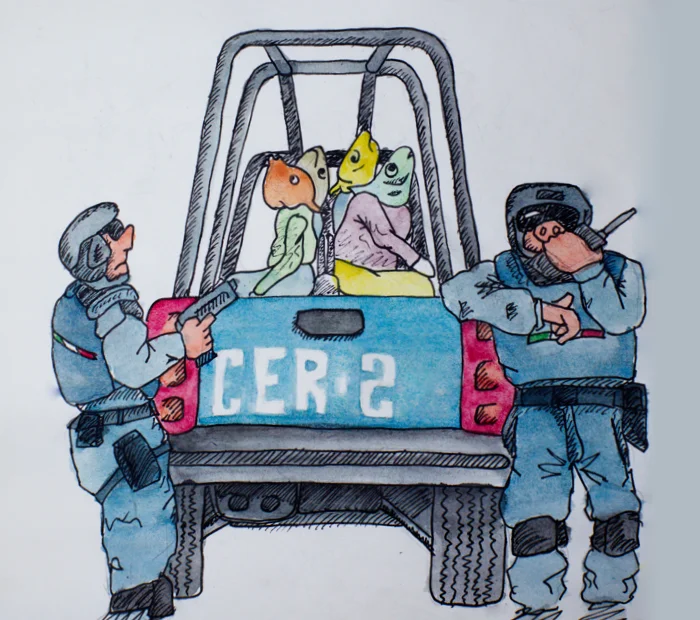
Illustration by Myself (Nomad Cook)
So, what does all of this have to do with Operación Pescador Oaxaca? A lot more than what you think. What lives matter to us? Who deserves to be considered human and who doesn’t? Instead of making a list, I think it will be easier to approach the answer with the people who are of interest to the interests of the most powerful of the world to extract from, like the people of the so-called Middle East whom they needed to dehumanize to be able to destabilize the region to gain political power and access to oil reserves there. If there’s any interest in taking anything from a group (including their land), we’re going to see all sorts of depictions of them that show people as angry, violent, foolish, stupid, and similar. As opposed to the way that powerful people are depicted: Tranquil, professional, relaxed, thoughtful, intelligent (and usually white men).
The fact that those stereotypes have been reproduced over and over everywhere for decades: Movies, TV shows, memes, newspapers; has made them a thing that we all believe colectivelly, as per today, and for years we have bought them just as a part of our society and they have shaped our perception and the way we think of people in such a subconscious level that we don’t even realize. The fact that there’s outrage only by a small sector of the population about those operations being conducted in plain sight is because we, as society, don’t care about those being abducted in the raids. They’re disposable, they don’t hold any power, and we perceive them with less humanity, in the same way we don’t care about people sieged in Gaza or all the population in The Democratic Republic of Congo who live in slavery to mine the coltan needed for our electronic devices, in a similar way to how people care about unhoused and racialized people in touristic spaces in Oaxaca.
I’m going to remind you of those two cases that happened in a two-month window in Mexico. Both of them, the cruel killing of innocent people in their vehicles, and then incinerated. The first one attracted the attention of all the media and the indignation of the population. The second one didn’t even make it to the mainstream media. The difference? One was a white family from the US in the north, and the second one, a musical band of indigenous youth in the south. I keep asking myself, why does one crime matter more than the other for the media and the population? Well, our biases are well defined.
These are the type of mechanics that people with power and elites use to clear their playgrounds to keep taking power from the people, and discard them as if they were chess pieces. When we talk about gentrification in places like Oaxaca is also important to keep an eye open to those techniques that are not mentioned often, and how they’re accepted and supported by the general population, because we actually believe they’re doing something good for society.
Sources
- Ray Chagoya, el priista que quería ser morenista y terminó en el Verde.
- Operación Pescador se extenderá a la ZMO.
- Operación Pescador reduce 63% de incidencia delictiva en la Central de Abasto; participan más de mil elementos.
- Oaxaca. “Operación Pescador”: limpieza social disfrazada de operativo de seguridad.
- Inicia DDHPO investigaciones por quejas presentadas tras la “Operación Pescador” – Defensoría de los Derechos Humanos del Pueblo de Oaxaca.
- Mano Vuelta A.C. en Instagram: “La “Operación Pescador” en la Central de Abastos no es seguridad: es clasismo, racismo y criminalización de la pobreza.
- Masacran a familia estadounidense en México: al menos 9 muertos.
- Masacre en Guerrero: Asesinan y queman a 10 músicos indígenas; comuneros impiden paso a Fiscalía.